
Karachi · Barristers, Advocates & Legal Advisors
A chambers of barristers and advocates acting in contentious and non-contentious matters under Pakistani law: for corporations, government bodies, banks, developers and private clients, at every tier of the court system.
Where to start
Four kinds of client reach this chambers, and each is handled differently. Choose the one that fits.
Practice
How we work
Matters are assigned by expertise rather than by rota. A chambers of this size can carry a constitutional petition, a banking suit and a cross-border succession at the same time without diluting any of them, because each goes to the member whose practice fits it.
Authoritative opinions on statutes, regulations and frameworks, so a client knows where an activity stands before committing to it.
Drafting, review, vetting and negotiation, with each document built to hold the client's position if it is later tested.
Representation at every tier, from tribunals and District Courts to the High Court, the Supreme Court and the Federal Constitutional Court, and in arbitration and mediation.
Navigating licensing, tariff and enforcement regimes, including energy, procurement, banking, tax and telecommunications.
Leadership
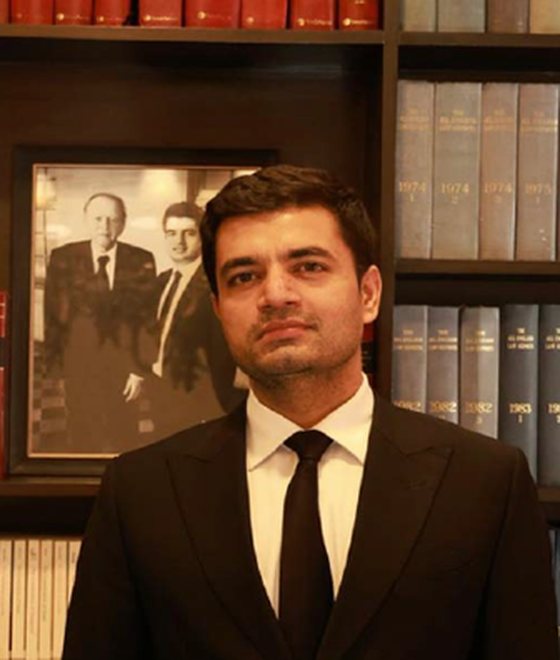
“A client does not come to us for an opinion on the law. They come because something has gone wrong and they need it put right. Everything this chambers does is arranged around that: the brief goes to the member whose practice actually fits it, the file is prepared before it is filed, and the client is told the position on the day it changes, not when they chase.”

“I sat as a Civil Judge and Judicial Magistrate before returning to practice, and it changed how I prepare. You learn quickly which applications a court will entertain and which it will not, and that is a different skill from knowing what the statute says. Our clients get the benefit of that judgment before a matter is instituted.”

The Chambers
Reported judgments, statutes and commentaries kept current, because an argument that turns on authority is only as good as the authority you can put in front of the court.
About the firmForums
The Twenty-seventh Amendment redrew the top of this structure in November 2025, and the original civil side of the High Court has since gone to the District Courts. A matter rarely stays where it starts, and because the chambers appears at every level, an appeal does not mean handing your file to someone new.
Created by the Twenty-seventh Amendment in November 2025 and now the highest court for constitutional matters. It holds exclusive jurisdiction over the interpretation of the Constitution, the enforcement of fundamental rights and disputes between the Federation and the provinces, together with appeals from the High Courts that raise a substantial question of constitutional interpretation. Its rulings on questions of law bind every court, including the Supreme Court.
Since the Twenty-seventh Amendment the Supreme Court sits as the final appellate court in matters that do not turn on constitutional interpretation: civil and criminal appeals, petitions for leave to appeal, and, as the Court has since confirmed, appeals in family and rent matters decided by the High Courts. Barrister Shah was enrolled at this bar at thirty-one and spent two years posted here as an Additional Advocate General.
The High Courts, and for this chambers the High Court of Sindh above all, no longer exercise an original civil side; suits that once began here are now instituted in the District Courts. What remains is substantial: writ jurisdiction under Article 199, appeals and revisions from the courts below, company and banking jurisdiction, admiralty, and the criminal appellate side. This is where most of the chambers’ contentious work is conducted.
Now the courts of first instance for civil suits of every value in Karachi, following the transfer of the original side. Suits, sessions trials, appeals from the civil judges, rent, family and guardianship, and execution. Across Karachi South, East, West, Malir and Central, and further into Hyderabad and Sanghar where matters require it.
Banking Courts, Anti-Terrorism Courts, Accountability Courts, the Intellectual Property Tribunal, Customs, Income Tax and Environmental Tribunals, and the Consumer Courts. Each has its own procedure, and each rewards counsel who knows it.
Domestic and institutional arbitration, mediation and expert determination, together with applications to appoint, to set aside and to enforce awards. Frequently the faster route where the contract allows it.
Representative Work
The following is illustrative rather than exhaustive, and is limited to matters of public record or where the client has consented to disclosure.
Read our commentaryActing for a food manufacturer, obtained an order restraining a public land authority from executing a lease over a 3.35-acre SITE plot pending four connected appeals.
Petition on behalf of a fuel marketing company challenging investigative freeze notices and the withholding of receivables, with interim relief continued.
Successfully resisted a leave to defend application in a corporate recovery matter, taking the suit to final decree proceedings.
Conduct of thirty-eight connected rent matters before the Rent Controller, with consolidated evidence and cross-examination strategy.
Clients
Listed corporates and multinationals, provincial and municipal authorities, energy and utility companies, commercial banks, developers and private individuals. A representative selection follows.
Recovery suits, enforcement of security, regulatory compliance and Banking Court litigation.
Licensing and regulatory matters, enforcement proceedings and supply disputes.
Governance, commercial contracts, mergers and acquisitions, and commercial litigation.
Public law and constitutional matters, service proceedings, procurement and revenue litigation.
Title and allotment, conveyancing, regularisation and project-level disputes across Sindh.
Individuals and families, including overseas Pakistanis holding assets in the country.
Common questions
Answered plainly, including where the answer is not what you were hoping for.
Ask us something elseLitigation is billed as a flat fee per case, assessed on the complexity of the matter rather than on hours. The full fee and the projected expenses are payable in advance, and that fee covers the matter from institution to final resolution regardless of how long it runs or how many appearances it requires. Appeals, arbitration and mediation are separate engagements. Transactional work is billed on a fixed fee set at the outset.
Honestly, longer than you would like, and we will not pretend otherwise. A straightforward civil suit at first instance commonly runs two to four years; a constitutional petition can be decided in months or can sit for years depending on the bench and the subject. What we can control is that the file is never the reason for a delay: papers are ready before the date, and adjournments are not sought on our account.
Yes, and a substantial part of our private client work is for Pakistanis resident abroad. Instructions can be given by video conference and a power of attorney executed and attested at the Pakistani mission in your country. You will not usually need to travel, though there are a small number of proceedings where personal attendance cannot be dispensed with, and we will tell you at the outset if yours is one of them.
Regularly. We act both for and against public authorities, and we run a conflict check before accepting any instruction so that we are never on both sides of the same dispute. Where we already act for the authority concerned we will tell you so and decline, rather than take the file and manage around it.
You bring whatever papers you have, we take instructions, and you leave with a view rather than a brochure: whether there is a case, which forum it belongs in, roughly how long it will take, and what it will cost. If we think the matter is not worth running, we will say so. That advice is often the most valuable thing we give.
Yes. Every matter we conduct is maintained on our case management system, and clients are issued a portal login. You can see the current stage, the last order passed, the next date and the documents on the file, and message the counsel conducting your matter directly. Positions are updated on the day of the hearing, not when you chase.
Instruct the firm
Send the forum, the stage and a short summary. We come back with an initial view and whether we are the right chambers for it. Sending an enquiry does not create a lawyer and client relationship; that arises only on a signed engagement.
Case portal
Every matter we conduct is maintained on a single case management system. Clients see the current position of their own files; members of the firm run the cause list, compliances and accounts from the same record.